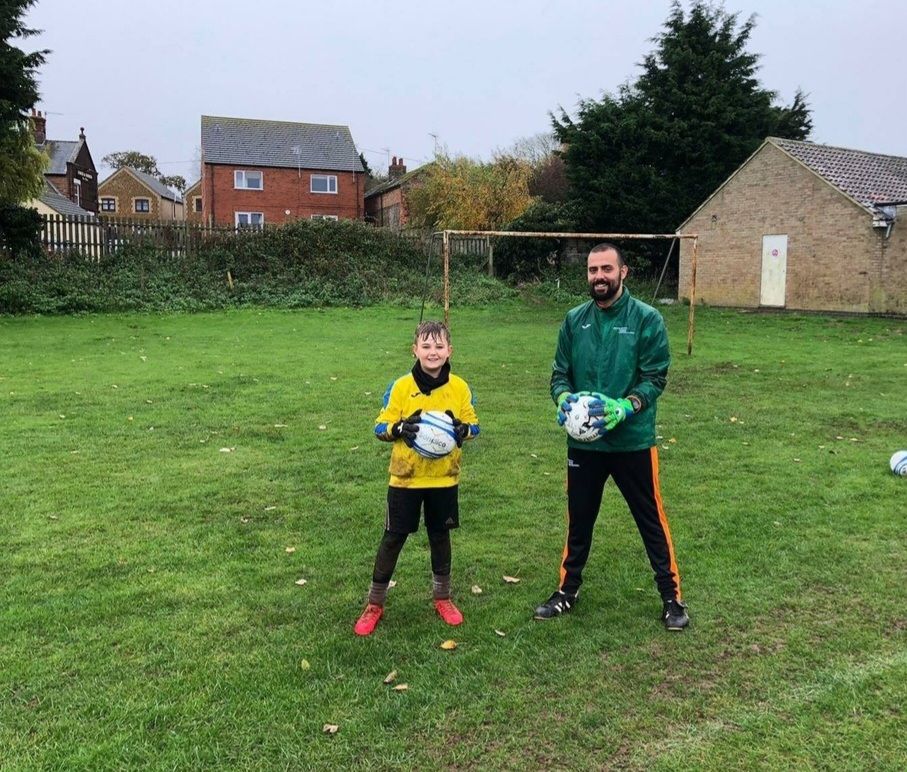
Think about the last time your child's team trained. How much of that session was dedicated specifically to goalkeeping? Probably very little. Maybe a few crosses at the end. Perhaps some shooting practice — but that's for the attackers, not the goalkeeper.
This is the reality for most young goalkeepers in the UK. And it's not anyone's fault — a team coach with 15 outfield players and one goalkeeper simply cannot give the goalkeeper the individual technical time they need within a standard session.
The result is that most young goalkeepers develop slowly, pick up bad habits that are hard to correct later, and lose confidence when those habits show up in matches.
The solution is specialist 1-to-1 goalkeeper coaching — sessions designed entirely around the goalkeeper's specific technical, physical and mental development needs. But to understand why that matters, you first need to understand what those technical areas actually are.
The 5 Technical Areas
Shot Stopping & Handling
Shot stopping is the most visible part of goalkeeping and the area most people think of first. But clean, confident handling — actually catching and holding the ball securely — is just as important as the save itself. A goalkeeper who palms the ball back into danger, or who spills crosses under pressure, costs their team goals even when they technically "stopped" the shot.
Young goalkeepers need to develop the correct hand shape for different types of saves — the W shape for shots at chest and head height, the scoop for low balls, the overarm catch for high deliveries — and they need to practise these movements under realistic pressure, not just in static drills.
They also need to work on their reaction saves — the instinctive, split-second responses to deflections, rebounds and close-range shots. These require fast-twitch muscle training and specific drill repetition that rarely happens in standard team sessions.
- Correct hand shape and body position for every save type
- Reaction save drills at varying distances and angles
- Handling under pressure — simulating match-realistic service
- Parrying technique — when to hold, when to deflect and where
- Diving technique — correct body position, landing, recovery
Positioning & Angles
Positioning is the area that separates good goalkeepers from great ones — and it's almost entirely invisible to the untrained eye. A well-positioned goalkeeper makes saves look easy. A poorly positioned one makes easy shots look difficult.
The fundamental principle is angle reduction — moving off the line to narrow the angle available to the striker. But real match positioning involves far more than that. It requires understanding where the ball is, where the danger is coming from, where your defenders are, and how to position your body to deal with the most likely threat while remaining ready to adjust.
Young goalkeepers often default to standing on their line. They haven't been coached on the why behind positioning decisions — so they make reactive saves when they should be making positioning-based saves that never need to happen at all.
- Starting position relative to ball position across the pitch
- Angle reduction — understanding the geometry of goalkeeping
- Positioning for crosses and set pieces
- Reading the striker's body shape to anticipate shot direction
- Repositioning quickly after distribution
A goalkeeper who understands positioning makes saves before the shot is even struck. That's the level we're working towards in every session.
Footwork & Movement
Modern goalkeeping demands far more from a goalkeeper's feet than it did even ten years ago. The evolution of the game — particularly the increasing expectation that goalkeepers act as sweeper-keepers and play as an additional outfield player in build-up phases — means that a goalkeeper's footwork is now as technically important as their handling.
But even at grassroots and youth level, footwork fundamentally affects shot stopping ability. A goalkeeper whose feet are in the wrong position when a shot arrives cannot get into the correct body shape to make the save. Good footwork is the foundation that everything else is built on.
This includes the set position — the moment just before a shot is struck when the goalkeeper bounces lightly onto the balls of their feet to generate explosive lateral movement. Most young goalkeepers have never been taught this. Once they learn it, their reaction speed to shots noticeably improves.
- The set position and explosive lateral movement
- Lateral shuffle technique — staying balanced while moving across goal
- Forward and backward movement — getting off the line and recovering
- Footwork for 1v1 situations — closing down without being beaten
- Ball control and passing technique for playing out from the back
Distribution
Distribution — how a goalkeeper restarts play after making a save or receiving a back pass — is one of the most overlooked technical areas in youth goalkeeping. Yet at every level from grassroots to academy football, poor distribution directly leads to goals.
Distribution covers a wide range of technical skills: the accuracy of a short roll-out to a defender under pressure, the length and precision of a goal kick, the timing and technique of a thrown distribution to switch play quickly, and the ability to play short passes accurately under pressure in a high press.
In modern football, goalkeepers are increasingly expected to be comfortable with the ball at their feet and to make quick, accurate decisions under pressure. Young goalkeepers who develop strong distribution skills have a significant competitive advantage — and those who don't find that it becomes a genuine weakness that opponents target deliberately.
- Throwing technique — overarm, underarm, javelin throw for different distances
- Kicking technique — goal kicks, volleys and half-volleys for distance and accuracy
- Short distribution under pressure — rolling and passing accurately
- Decision making — when to play short, when to go long
- Playing out from the back with confidence under a high press
Communication & Confidence
Goalkeeping is the one position where you can see the entire game in front of you — and that means the goalkeeper is uniquely placed to organise, direct and communicate with their defence. A goalkeeper who communicates effectively makes the whole team better. A goalkeeper who doesn't, leaves defenders uncertain and vulnerable.
Communication is a technical skill in goalkeeping, not just a personality trait. It covers the specific calls used for crosses — "keeper's ball," "away," "man on" — the ability to organise a defensive wall at a free kick, alerting defenders to runners at set pieces, and the constant stream of positional information that should flow between the goalkeeper and their back four throughout a match.
Confidence underpins all of this. A goalkeeper who is uncertain of their positioning, unsure of their handling, or anxious about distribution will go quiet when the game gets difficult. Confidence in goalkeeping is built through repetition, through mastering the technical fundamentals, and through having a coach who creates the right environment for learning from mistakes without fear.
- Specific calls for crosses, set pieces and defensive organisation
- Wall organisation technique and free kick positioning
- Command and authority — voice projection and timing of calls
- Mental resilience — recovering quickly after conceding
- Building match confidence through realistic pressure training
Why Team Training Isn't Enough
Understanding these five areas makes it obvious why standard team training rarely develops young goalkeepers effectively. A team coach dividing their attention across 15 or 16 players cannot dedicate the repetition, technical detail and individual feedback required to develop a goalkeeper across all five of these areas simultaneously.
In a typical 90-minute team session, a goalkeeper might receive 10 minutes of goalkeeper-specific work — often at the end of the session, often involving being a target for shooting practice rather than genuine goalkeeper development.
That's not enough. Not if your goalkeeper has genuine ambitions. Not if they want to play at a higher level. And not if they're losing confidence because bad habits that were never corrected are now costing them in matches.
The answer isn't to criticise team coaches — it's simply to recognise that specialist 1-to-1 goalkeeper coaching fills a gap that team training structurally cannot fill.
My son is 3 weeks into a 6-week training block with Giuseppe. The sessions have been really good. Giuseppe has a calm and relaxed manner and immediately put my son at ease — while working him hard and challenging him throughout. The improvement is evident.
What to Look for in a Specialist Goalkeeper Coach
Not all goalkeeper coaching is equal. When looking for a specialist coach for your young goalkeeper, here are the key things to consider:
Specific goalkeeper coaching experience — has the coach worked with goalkeepers at a meaningful level? General football coaching qualifications are valuable, but goalkeeping is specialist enough that relevant coaching experience matters significantly.
Academy-level knowledge — a coach who has worked within academy environments understands the technical standards that scouts and academy coaches are looking for. That knowledge filters directly into the development programme they build for your goalkeeper.
Individual session structure — a good goalkeeper coaching session is not the same as a team training session with only one player. It should be structured, progressive, and focused on specific technical areas that are right for that goalkeeper's current level and development needs.
Verifiable results — look for reviews from other parents and players. Results matter. A coach who has helped young goalkeepers improve their confidence, develop technically and progress to higher levels of football is demonstrably delivering what they promise.
The Right Age to Start Goalkeeper Coaching
One of the most common questions parents ask is when their child should start working with a specialist goalkeeper coach. The honest answer is: earlier than most people think.
Bad habits form early and become increasingly difficult to correct as players get older and more physically developed. A young goalkeeper who is taught the correct diving technique, the correct set position and the correct hand shape from an early age will progress dramatically faster than one who spends years developing the wrong patterns and then has to unlearn them.
For younger players (ages 6–12), goalkeeper coaching should be fun, confidence-building and focused on the fundamentals — handling, footwork and basic positioning. The technical demands should increase as the player gets older and more physically capable.
For older players (13+) and adult goalkeepers, sessions become more technically intensive and tactically sophisticated, incorporating distribution under pressure, communication drills, set piece organisation and the mental side of goalkeeping under competitive conditions.
Does Your Goalkeeper Need Specialist Coaching?
Giuseppe provides specialist 1-to-1 and small group goalkeeper coaching sessions at Fives Wigan, with 56 five-star verified reviews from players and parents across Greater Manchester, Wigan, Bolton, Golborne and Sale.
Find Out More About Giuseppe →The Bottom Line
The five technical areas covered in this guide — shot stopping and handling, positioning and angles, footwork and movement, distribution, and communication and confidence — form the complete foundation of what it means to be an effective modern goalkeeper.
Team training develops some of these, some of the time. Specialist individual goalkeeper coaching develops all of them, specifically, with the repetition and individual feedback required to actually improve.
If your child is serious about goalkeeping — if they want to play at a higher level, reach an academy or simply become the best goalkeeper they can be — specialist coaching is not an optional extra. It is the fastest and most direct route to the development they need.